the sequence of tenses 時態的一致
決定動詞的時態的=動詞的時間和狀態
[例一:現簡-現完簡-未簡]
Our postman usually delivers our mail at 7 every morning. It‘s nearly lunch-time and the mail still hasn’t arrived. I suppose the mail will come soon. Perhaps our postman is ill.
[例二:過簡-過完簡]
When I lived in London the postman usually delivered our mail at 7 every morning. Usually no one in our household had got up when the mail arrived.
[例三:過簡-過進-過完簡]
On March 14th at 10.15 a.m. I was waiting for a bus at the bus stop on the corner of Dover Road and West Street when a black Mercedes parked at the stop. Before the driver (had) managed to get out of his car, a number 14 bus appeared …
[例三:過簡-過進]
lt was just before the Second World War. Tom was only 20 at the time and was living with his mother. He was working in a bank and travelling to London every day. One morning, he received a mysterious letter. It was addressed to ‘Mr Thomas Parker’.
[例四:過簡-過完簡]
When we returned from our holidays, we found our house in a mess. What had happened while we had been away? A burglar had broken into the house and had stolen a lot of our things. [<—搶案和我們回家的時間先後的連結—-繼續搶匪的過程—->]The burglar got in through the kitchen window. He had no difficulty in forcing it open. Then he went into the living-room …
[例五:過簡-過完簡]
Silas Badley inherited several old cottages in our village. He wanted to pull them down and build new houses which he could sell for high prices. He wrote to Mr Harrison, now blind and nearly eighty, asking him to leave his cottage within a month. Old Mr Harrison was very distressed. He had been born in the cottage and stayed there all his life. His children had grown up there; his wife had died there and now he lived there all alone.
<一般狀態>
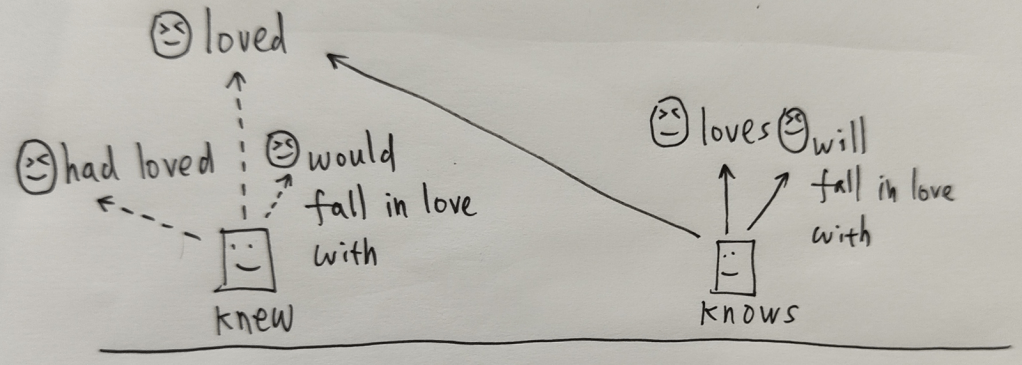
Tom knows that Peter loved the girl.
Tom knows that Peter loves the girl.
Tom knows that Peter will fall in love with the girl. [Tom現在知道Peter未來將喜歡]
Tom knew that Peter had loved the girl. [Tom過去知道(時間點在更早)Peter過去喜歡]
Tom knew that Peter loved the girl.
Tom knew that Peter would fall in love with the girl.
<無關時間的事實/真理狀態=現在式>
Galileo knew that the earth goes around the sun. [伽利略知道地球繞著太陽轉]
Galileo knew that the earth went around the sun. (x)
Galileo knew that the earth had went around the sun. (x)
Galileo knew that the earth would go around the sun. (x)
讓意思清楚=過去式有現在式, 現在式有過去式
Tom said that he went jogging every morning.(o)
Tom told me he was a good tennis-player. (o)
<–兩個都是過去式,不清楚現在的狀況
Tom said that he goes jogging every morning.(o)
<–動作動詞現簡=包含過去/現在/未來都反覆的動作
When he worked here, Roger was always making mistakes.(o)
<–過簡=過去反覆動作
Tom told me he is a good tennis-player.(o)
<–表示過去+現在都是
Tom tells me he used to be a good tennis-player.
I played football every day when I was a boy.
<–表示過去是,現在不是
Tom said that he has blue eyes.
<–過去到現在都不會變的事物
<歷史事件=過在式,不必用過去完成>
Tom knew that the temple was built in 1700. (o)
<–歷史事件用過去式,因不會造成前後關係不清的情形,不必用過去完成
<過去的未來=現在的未來 — 可用will/would>
Tom said he would go to Japan the next year. (o)
<–過去說的,the next year是指過去的next year=說話的隔年,表示現在不知去了沒
Tom said he will go to Japan next year. (o)
<–過去說的,next year是指現在的next year=明年,表示現在還沒去
<時間表timetable/行事曆calendar:=現代未>
The concert begins at 7.30 and ends at 9.30.
We leave tomorrow at 11.15 and arrive at 17.50
<報導的標題headlines或照片字幕photographic captions>
現簡=過去式
US and Russian defence ministers hold rare talks
現進/不定詞=未來
WHO to Deploy Experimental Ebola Vaccines to Uganda
WHO Deploying Experimental Ebola Vaccines to Uganda
have been 現完(省掉了)
VILLAGES DESTROYED IN EARTHQUAKE (= have been destroyed)
<過去簡單/過去進行-用於Poplite inquiries禮貌地詢問時,沒過去時間的意思>
常用動詞= hope, think or wonder.
I wonder if you could give me a lift.
I wondered if you could give me a lift. [過簡-較禮貌]
I was wondering if you could give me a lift. [過進-更有禮貌]
<希望去做但沒完成者=過完>
動詞: expect, hope, mean, suppose, think, want
I had hoped to send him a telegram to congratulate him on his
marriage, but I didn ‘t manage it.
<過簡或現完簡?>
前後發生順序語意清楚時,可不用現完簡
(關係子句常會很明顯)
After I finished, I went home.
I wore the necklace (which) my grandmother (had) left.
I got out of the taxi, paid the fare, tipped the driver and dashed
into the station.
但若要精確表達時,不可省
When I arrived, Anne left. (i .e. at that moment)
When I arrived, Anne had left. (i .e. before I got there)
<完簡 或 完進?>
I’ve been painting this room. <–活動還没結束
I’ve painted this room. <–活動己結束
When I got home, I found that Jill had been painting her room. <–那時,活動還没結束
When I got home, I found that Jill had painted her room. <–那時,活動己結束
[參考1] [參考2] [參考3] [參考4] [參考5]
eg.
 ziziqi.design.blog